

June 15, 2026
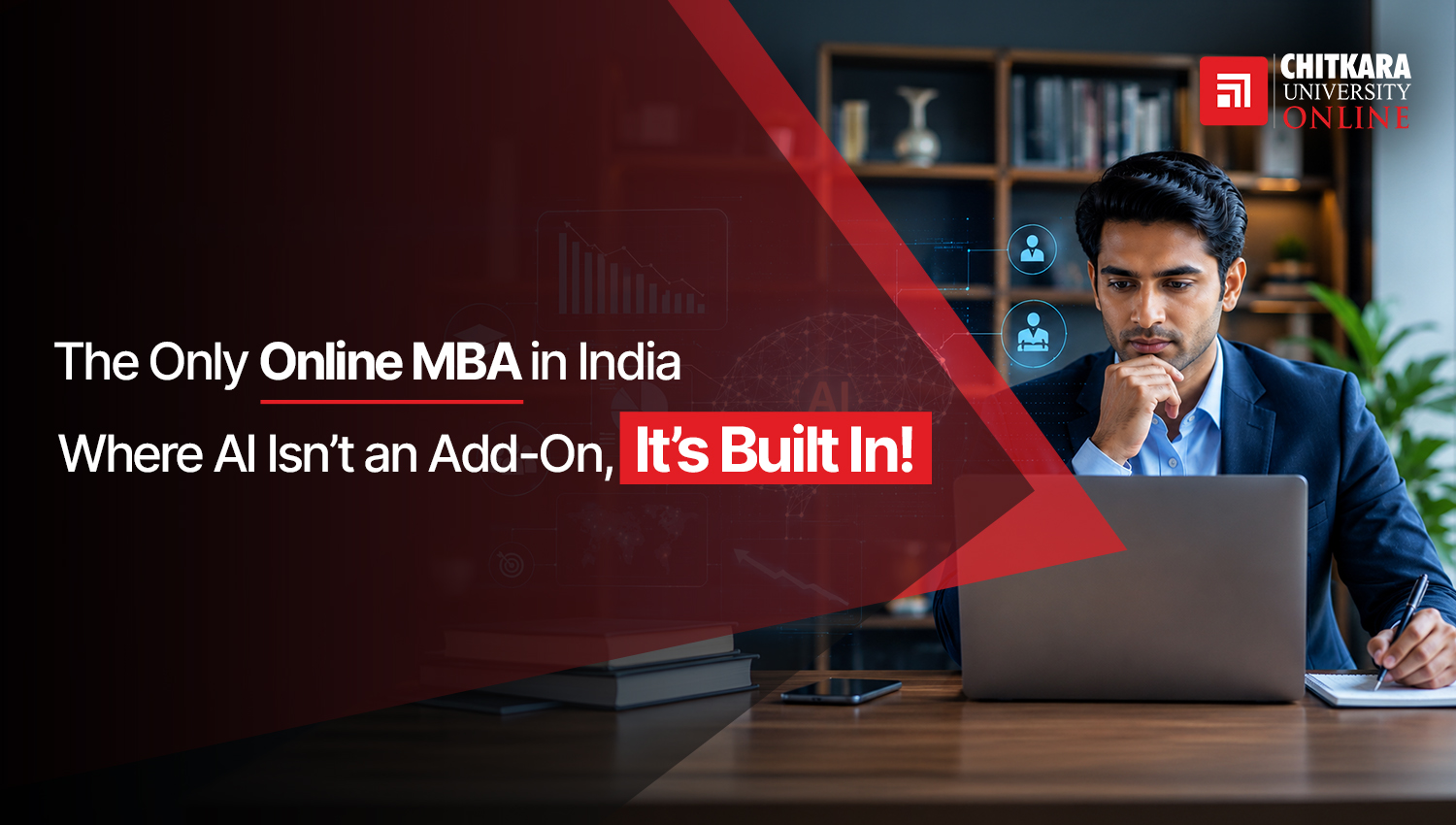
Most MBA programs in India now mention AI somewhere in their curriculum. A module here, an elective there, a workshop at the end of semester two. That is not an AI-integrated MBA. That is a traditional MBA with AI sprinkled on top. The difference matters because it determines whether you graduate able to use AI in real management decisions, or whether you can describe AI at a high level but never actually worked with it in a business context.
An online MBA with AI that genuinely integrates artificial intelligence into its core curriculum teaches you to make data-driven decisions in Finance, use AI for market analysis in Marketing, apply machine learning outputs to Operations, and build AI-informed HR strategy. ChitkaraU Online’s Online MBA in Data Science and AI, delivered in knowledge partnership with EY, was built on this principle: AI is not a subject you study. It is the lens through which you study everything.
Key Takeaways
- India’s demand for AI professionals is projected to exceed 1 million by 2026, against a current supply of approximately 416,000. This represents a 51% demand-supply gap that is creating significant salary and career premiums for AI-literate management professionals (NASSCOM).
- India’s AI market is growing at a CAGR of 25-35% and is projected to reach $17 billion by 2027, driven by enterprise AI adoption across BFSI, e-commerce, manufacturing, and healthcare (NASSCOM-BCG).
- Only 16% of India’s IT professionals are currently AI-skilled, despite AI/ML job postings growing at 15%+ annually and AI engineer roles rising 67% year-on-year.
- An AI integrated online MBA that builds AI into core subjects, not as an elective, prepares graduates to operate at the intersection of business and technology, the most in-demand professional profile in India’s 2026 job market.
- The EY knowledge partnership brings industry-led AI curriculum, real business case application, and exposure to the tools and frameworks that Indian organisations are actively deploying right now.
How the MBA Landscape in India Changed and Why AI Knowledge Now Matters
The traditional MBA was built for a world where the challenge was managing information scarcity. Leaders needed frameworks to structure decisions with limited data. That problem no longer exists. India’s largest enterprises now generate more data in a day than their analysts can process in a month. The new challenge is not collecting data. It is having managers who can extract business meaning from it and act on it faster than competitors.
This is why an online MBA in India that includes AI and data science has become more than a differentiator. For professionals aiming at roles in BFSI, consulting, e-commerce, manufacturing, and technology services, it is increasingly a baseline expectation. NASSCOM data shows that AI and data science skills are growing at 30% year-on-year in demand, while the supply of qualified professionals lags by more than half. The professionals who combine management credibility with genuine AI literacy are commanding the outcomes on both salary and career progression.
The MBA hasn’t been replaced. It has been upgraded. The core remains: strategy, finance, leadership, operations. What has changed is the toolkit those disciplines run on.
Also Read: Why an EY-Backed Data Science Online MBA Outlasts Any Bootcamp for Your Entire Career
What Makes an Online MBA With AI Different From One That Just Adds AI Courses
The distinction between a genuine online MBA with AI and a traditional MBA with AI modules added is structural, not cosmetic. It determines what you can actually do after graduation.
- AI runs through every subject, not one: In a genuinely AI integrated online MBA, you are not studying “AI in Business” as a standalone course. You are using AI tools and analytical frameworks in your Finance modules, your Marketing strategy projects, your HR analytics assessments, and your Operations coursework. The intelligence layer is inseparable from the management layer. This is how real businesses work, and this is what the curriculum should reflect.
- Business problems drive the AI learning, not the other way around: A bolted-on AI module typically teaches what AI is and how it works in theory. A built-in approach starts with a business problem (how do we reduce customer churn, optimise our supply chain, or price this product) and then introduces AI and data tools as the means of solving it. The business-first framing produces professionals who can apply AI in practice, not just describe it in interviews.
- You graduate with tools, not just frameworks: An MBA with AI that is genuinely integrated gives you hands-on experience with the platforms that Indian organisations are actually using: data analytics environments, AI decision-support tools, machine learning output interpretation, and business intelligence dashboards. When you walk into a job interview, you have worked with these tools, not just read about them.
- Faculty and content reflect current industry, not two-year-old syllabi: The AI landscape evolves faster than most academic institutions can update their courseware. The EY knowledge partnership addresses this directly. EY’s involvement means the curriculum reflects what their client organisations, some of India’s and the world’s largest enterprises, are actually implementing in AI right now, not what was current at the time of the last syllabus review.
The EY Knowledge Partnership: What Industry Delivery Actually Means for Students
The EY knowledge partnership in ChitkaraU Online’s MBA with AI India is not a logo on a brochure. It represents a specific structure of curriculum co-design and content delivery that changes what the program actually teaches.
EY India is one of the Big Four professional services organisations, advising enterprises across BFSI, technology, healthcare, and manufacturing on their AI and digital transformation strategies. The perspectives they bring into the curriculum reflect the decisions that real organisations are making with real AI investments today: how to evaluate data infrastructure, how to build AI governance, how to translate model outputs into business strategy, and how to manage the human side of AI-driven change.
For students, the practical impact is this: the case studies you work through are not fictional scenarios from a textbook. They are drawn from the kinds of challenges that EY’s client organisations face. The frameworks you learn have been tested against actual business problems. The industry exposure you gain is structured and relevant, not a guest lecture from an alumnus who works in a vaguely related field.
For a detailed look at how this compares to short-form alternatives, Agentic AI in Business Management: Why ChitkaraU Online’s Programs Are Teaching It Right Now covers how the program is building competency in AI capabilities that other programs haven’t even added to their curriculum yet.
Why India Needs MBA Graduates Who Understand AI Right Now
India is experiencing a structural shortage of professionals who combine management capability with AI literacy. The numbers from NASSCOM are specific: demand for data science and AI professionals in India is projected to exceed 1 million by 2026. Against a current talent base of approximately 416,000 professionals, the gap stands at 51%. That is not a rounding error in the talent market. That is a structural shortage that is driving salary premiums across every sector where AI adoption is accelerating.
India’s AI market is projected to reach $17 billion by 2027, growing at a CAGR of 25-35% (NASSCOM-BCG). Roles carrying the highest demand-supply gap, including ML engineer, data scientist, and data architect, are all seeing shortfalls of 60-73%. For management professionals who can bridge the analytical and strategic layers, the opportunity is significant.
The 16% AI-skill penetration figure is equally important. With only one in six Indian IT professionals currently AI-skilled, the competitive advantage of graduating with a genuine online MBA with AI is not marginal. It is the difference between being in the top 16% and the bottom 84% in the most in-demand professional skill of the decade.
Read More: AI Replacing Managers: What Indian MBA Graduates Must Actually Prepare For
Career Roles an AI Business Degree Opens Up in 2026
An online MBA with AI India that genuinely integrates artificial intelligence into its core curriculum opens a specific set of high-growth, high-demand roles that a conventional MBA typically does not.
- Analytics Manager and Business Intelligence Lead: These roles require professionals who can translate data outputs into strategic decisions, manage analytics teams, and communicate findings to senior leadership. They are among the fastest-growing management roles in BFSI, e-commerce, and consumer goods organisations in India right now.
- AI Product Manager: Organisations building AI-powered products need managers who understand both the business objectives and the technical constraints. An AI business degree builds exactly this: the ability to work with engineering teams without being an engineer, and to keep product decisions grounded in commercial viability.
- Digital Transformation Manager: As Indian enterprises migrate processes and decision-making onto AI and data platforms, they need managers who can lead the change without technical confusion or organisational resistance. This role requires AI literacy combined with leadership and stakeholder management: the exact combination a built-in AI MBA develops.
- Consulting and Strategy Roles in Technology-Led Practices: Management consulting firms and strategy practices are increasingly requiring analysts and associates to demonstrate AI and data literacy from day one. An online MBA with AI positions graduates for entry into these practices at a level that a conventional MBA typically does not support without additional certification.
The Online MBA in Data Science and AI at ChitkaraU Online is a fully online, UGC-entitled program delivered from a NAAC A+ accredited institution. It is designed for working professionals who need flexible scheduling, a UGC-recognised degree, and curriculum that actually reflects how India’s most competitive employers are using AI today.
If you are an engineer considering this program, Online MBA for Engineers: How Indian Tech Professionals Make the Engineer to Manager Switch covers how the Data Science and AI specialisation fits into the broader engineer-to-manager career path.
Frequently Asked Questions
1. What makes an online MBA with AI different from a traditional MBA in India?
A genuine online MBA with AI integrates artificial intelligence into every core subject: Finance, Marketing, Operations, HR, and Strategy. It is not a standalone AI module added to a conventional syllabus. Students learn to apply AI tools to real business problems across functions, rather than studying AI separately. The result is a graduate who can use AI in actual management decisions, not just describe it.
2. Is ChitkaraU Online’s MBA with AI suitable for non-technical professionals?
Yes. The program is designed for management professionals, not data engineers or AI researchers. The curriculum focuses on applying AI tools to business decisions, interpreting analytics outputs, and leading AI-enabled teams. No advanced coding or machine learning background is required. Professionals from Finance, Marketing, HR, and Operations backgrounds complete the program and move into AI-adjacent management roles.
3. What does the EY knowledge partnership add to the program?
EY India co-designs and contributes to curriculum content based on the AI and data challenges their enterprise clients are addressing today. This means case studies reflect real business scenarios, frameworks are tested against industry problems, and students gain exposure to the tools and practices that large organisations are actively deploying. The partnership converts academic curriculum into industry-relevant learning, not just theory.
4. What is the demand for AI-skilled management professionals in India in 2026?
NASSCOM data projects demand for data science and AI professionals in India to exceed 1 million by 2026, against a supply of approximately 416,000, a 51% gap. Only 16% of Indian IT professionals are currently AI-skilled. India’s AI market is projected to reach $17 billion by 2027 at a CAGR of 25-35%, creating strong salary and career premiums for AI-literate management graduates.
5. Can I pursue this AI business degree while working full-time?
Yes. ChitkaraU Online’s MBA with AI is fully online and designed for working professionals. The program offers flexible scheduling, asynchronous content access, and project-based assessments that can be completed alongside full-time employment. There is no requirement for campus attendance. The UGC-entitled degree carries the same academic and professional standing as a conventional campus-based MBA.
6. What career roles does an AI integrated online MBA in India lead to?
Graduates move into roles including Analytics Manager, Business Intelligence Lead, AI Product Manager, Digital Transformation Manager, and strategy consulting roles in AI-led practices. These are among the fastest-growing management positions across BFSI, technology, e-commerce, and consulting in India. The combination of management qualification and built-in AI literacy positions graduates for roles that a conventional MBA alone does not access.
 Copy link